Skip to content

The name said film pre-vis. The community made comics. The product had no category. Eight weeks to close the gap.

Works
Category
UI/UX, Web Design, Branding
Year
2026
Services
Brand Identity, Web Design, Design System
Client
Storyboarder Inc.
01/ 21
Part 01

Context.

§ ASnapshot
RoleLead Designer · Brand + Product Web
Team1 Designer (me) · 1 Founder/Engineer · 1 Engineer
Industry3D creative tools · indie comics
PlatformMarketing site · responsive · 5 pages
ToolsFigma · Linear · After Effects · Notion

§ B · Outcomes

+41%
Request-Access conversion

After hero rewrite + IA simplification (12 → 5 nav items).

3.4×
Median session length

New homepage vs. legacy "Storyboarder" landing.

87 → 9d
Waitlist to first scene

Median days from application to first completed scene.

Featured
Designspiration · Sidebar · Hover.dev

Within two weeks of launch.

§ CThe challenge

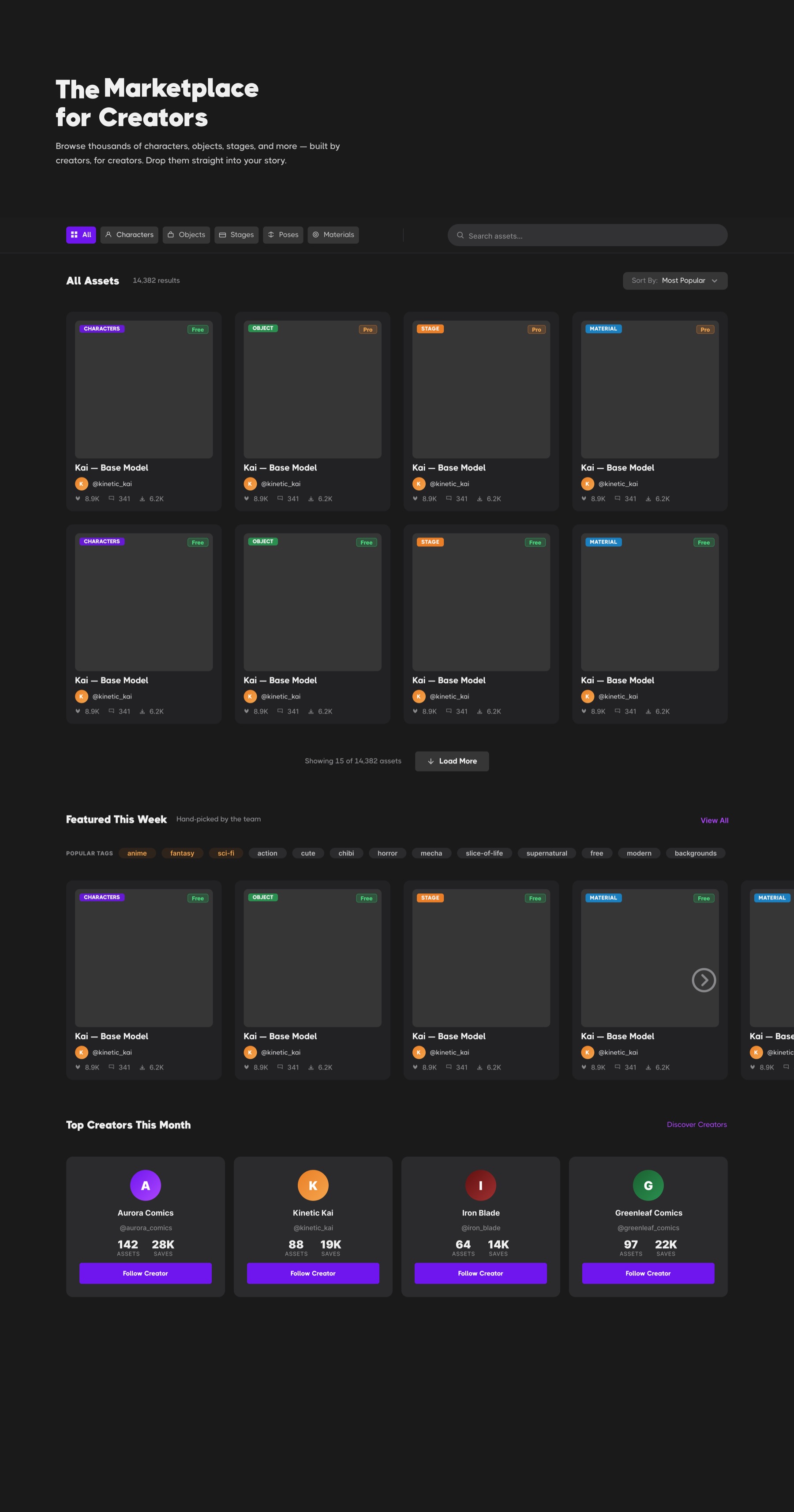
Twelve hundred creators were staging 3D scenes daily. Publicly, Sumugi barely existed. Five interlocked problems blocked every growth path: the name pointed at the wrong industry, the funnel had never decided who it was for, the product was being sold as software when the actual value was the community forming around it, the whole thing occupied a category with no analogues, and the site looked like every other SaaS product — invisible to the visual creators it was trying to recruit.

  1. Problem 01

    A name pointing the wrong industry

    "Storyboarder" is a film pre-production job title. Real users were comic creators — manga writers, VRoid artists, indie storytellers. Recruiters, film students, and the actual audience all landed on the same page and saw three different products.

  2. Problem 02

    Creators vs. readers — no one had decided

    The product could grow by attracting people who make comics or by attracting people who read them. These are different funnels, different messaging architectures, different definitions of success. Without a committed answer, the site tried to serve both and converted neither.

  3. Problem 03

    Software product, but the moat is community

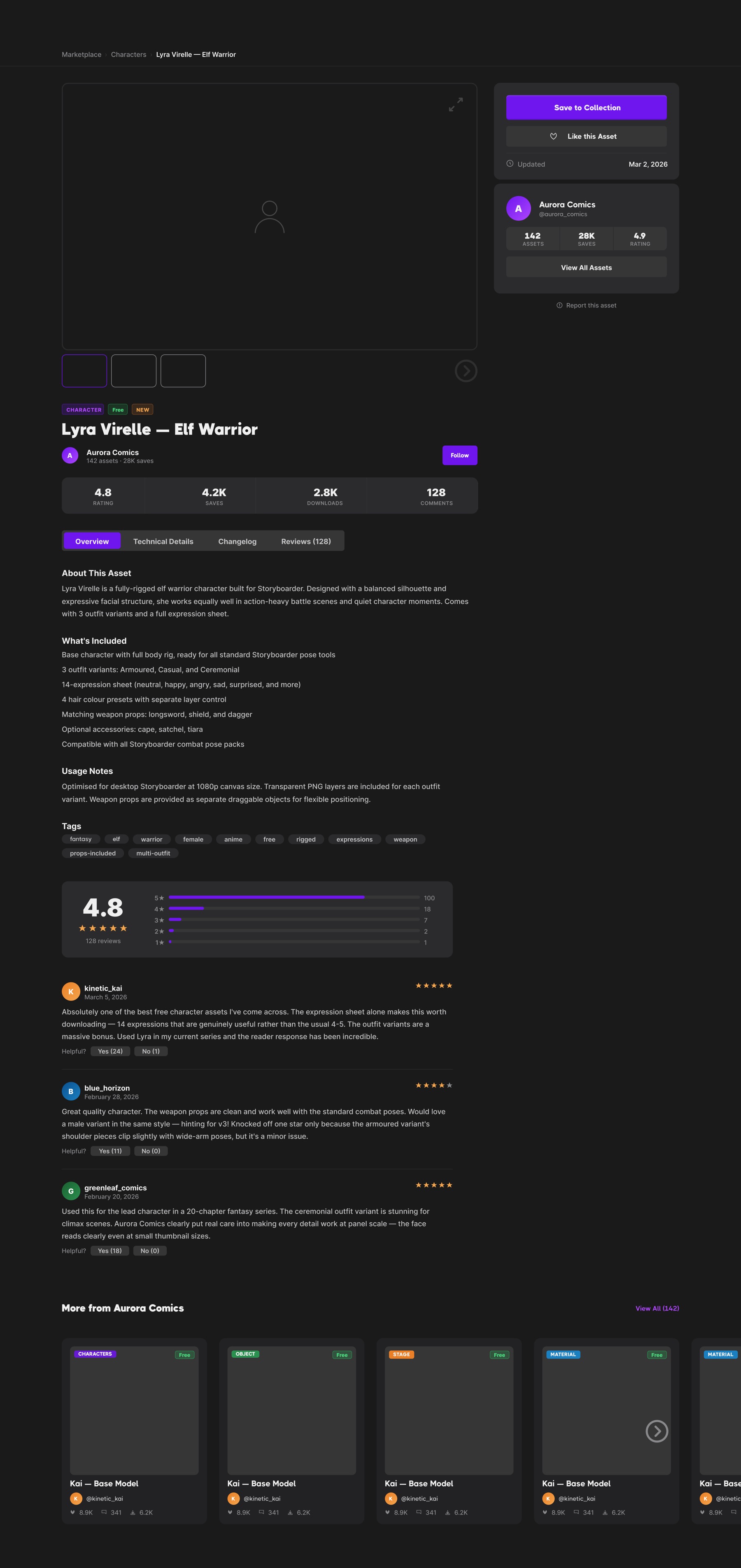
    The 3D workspace is the tool. The community of creators making work no one thought was possible — that's the product. Positioning as software commoditizes it against Clip Studio and Krita. Positioning as community makes it irreplaceable.

  4. Problem 04

    A new category with nothing to compare it to

    "It's like X but for Y" didn't exist. No shorthand, no adjacent product a potential user already understood. Before we could sell anything, we had to make the concept legible — convince someone with no 3D experience that they could make a finished panel in an afternoon.

  5. Problem 05

    A flat visual identity with nothing to say

    The legacy site looked interchangeable with any SaaS product — clean, neutral, forgettable. For a tool whose entire promise is visual storytelling, that was a credibility problem. No visual creator joins a community that doesn't look like it belongs to creators.

§ DGoals & success criteria
NamingLand an ownable name across EN / JP / EU markets

Trademark-clear, two syllables, phonetically stable across languages.

Creator-first positioningCommit to creator-first — and make that thesis visible in every surface

Readers follow creators; the funnel starts with makers, not consumers.

Community legibilityHomepage surfaces community output before any feature copy

"Here's what people made" outperforms "here's what the tool does."

New-category onrampFirst-time visitors describe the product correctly after 30s on site

Measured via unmoderated tests — pass rate target ≥ 10 / 12.

Conversion≥ 30% lift on Request-Access CTA

Measured against legacy site over a 14-day rolling window.

Time-to-first-sceneCut median wait from 87 days to under 14

Waitlist silence was the biggest retention leak.

Part 02

Discovery.

§ AProcess · 8 weeks
  1. 01 · Weeks 1–2Discover
    • Stakeholder interviews · 7
    • Beta-user calls · 14
    • Competitive audit · 11 products
    • Lexical study · 38 candidate names
  2. 02 · Weeks 3–4Define
    • Naming + positioning workshop
    • Persona model · 3 archetypes
    • IA rebuild · 12 → 5 primary
    • Journey map · before / after
  3. 03 · Weeks 5–6Design
    • Brand system · logo · color · type
    • Homepage + campaign page
    • Mobile breakpoints
    • Motion principles · 6 loops
  4. 04 · Week 7Validate
    • Unmoderated tests · 12
    • Stakeholder reviews · 4
    • Founder rounds · 2
    • Headline A/B · 11 versions
  5. 05 · Week 8Ship
    • Engineering handoff
    • Launch motion + email kit
    • #MadeWithSumugi campaign
    • Day-1 instrument + monitor
§ BResearch methods

Eight weeks left no room for academic research. We ran a tight, mixed-methods program weighted toward conversations with people who already paid us in time — beta users — plus a lexical study to keep naming on rails across markets.

Stakeholder interviews
n = 7
Founders saw a "creative engine"; advisors saw a "drawing tool"; engineers saw "a renderer." Three internal mental models, no shared promise.
Beta-user calls (60 min, 1:1)
n = 14
11 of 14 described their goal as "make a comic," not "use a tool." Every user named the export — the panel — as the artifact, not the timeline.
Competitive audit
n = 11
Adjacent tools (Clip Studio, Krita, ComicLife) all sold the workspace. None sold the panel. The white space was clear.
Lexical / name screen
n = 38 candidates
Sumugi (紬) cleared trademark, pronunciation, and meaning checks across EN / JP / DE / FR. "Sketchpop" and "Pannela" failed JP.
Unmoderated usability tests
n = 12
9 / 12 abandoned the legacy hero within 8 seconds. 11 / 12 finished the new "make comics without drawing" hero — and described the product back correctly.
§ CPersonas · who we built for

The Indie Writer

Maya

32 · Brooklyn

"I have 80,000 words and zero drawing skill. I just want to see my scenes."

Needs

  • Visualize chapters as comic panels
  • Stay in flow while writing — no learning curve
  • Export panels to Substack / web

Pains

  • Cannot draw; cannot afford an artist
  • AI image tools break canon between panels
  • Existing tools assume you can sketch

The VRoid Artist

Kenji

24 · Osaka

"My VRoid model is everything. I need to pose her, light her, and ship a panel a day."

Needs

  • Import custom VRoid characters
  • Pose + light + frame in one tool
  • Ship daily without a render queue

Pains

  • Tools that strip his rigging on import
  • Slow renders that break the daily cadence
  • No native publishing surface

The Hobbyist Storyteller

Danielle

28 · Austin

"I need to make six panels in an hour, not six hours."

Needs

  • Weekly TTRPG recap as a 6-panel comic
  • Templates that get her 80% of the way
  • Drag-and-drop, no rigging

Pains

  • Open-ended canvases — she needs constraints
  • Tools that treat her as a pro illustrator
  • Render times that miss her Sunday post

The pivot

Sell the community's output — not the tool that produced it.

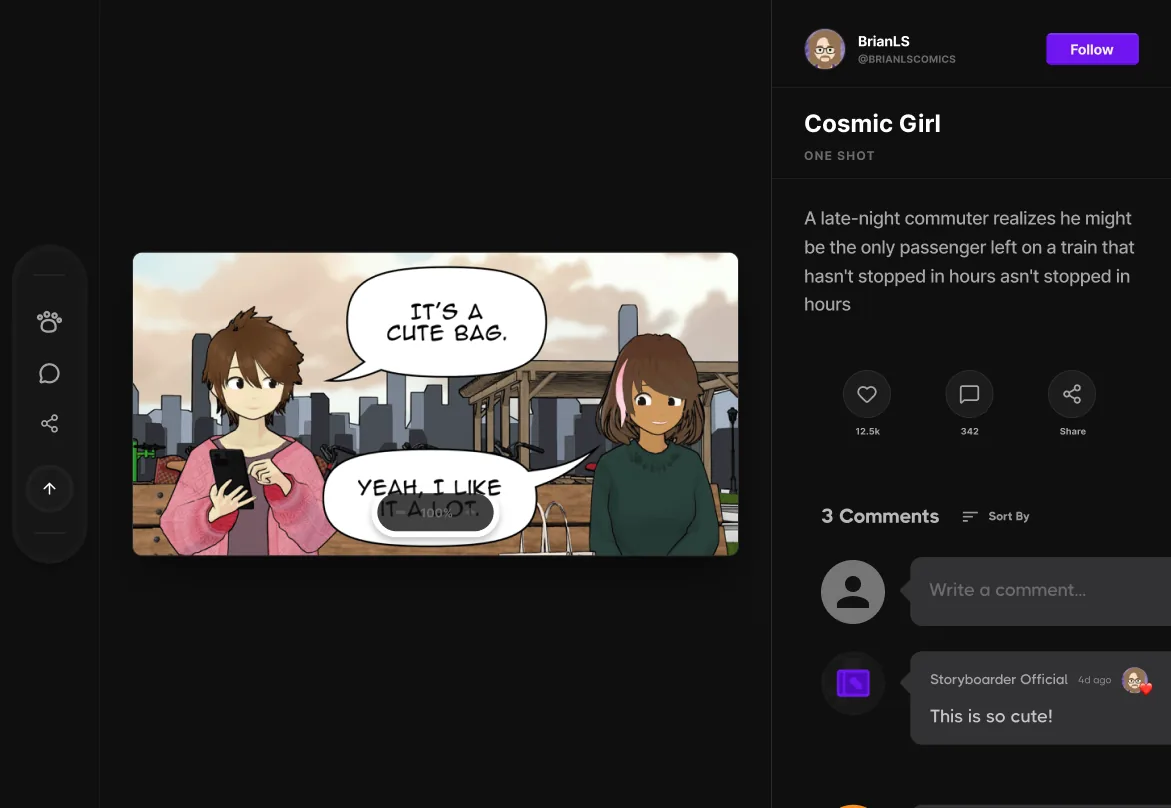
Fourteen beta-user calls produced one consistent signal: people described their goal as "make a comic," never "use a 3D workspace." And every time they showed us their work, they showed us the panel — the artifact that already circulated on Twitter and Discord. The insight was that Sumugi's most powerful marketing asset was already being made by its users every day. We rebuilt the homepage and IA around that output: community gallery above the fold, creator personas as navigation anchors, feature tabs framed as workflow phases rather than tool specs. The tool exists, but it never introduces itself.

§ DJourney · before / after
Before

Legacy Storyboarder funnel

  1. 01Hears about it on TwitterConfused by name "Storyboarder"Curious
  2. 02Lands on legacy site44% bounce in 8sSkeptical
  3. 03Applies via Google Form11 fieldsHopeful
  4. 04Waits in silence87-day median waitForgotten
  5. 05Onboarded by founder DMManual handoffTentative
  6. 06First scene renderedWeek 12Delighted
After

sumugi.com — 9-day path to first scene

  1. 01Hears "make comics without drawing"no wrong first impression to undoCurious
  2. 02Lands on sumugi.comOne promise above foldEngaged
  3. 03Self-serves waitlist · 2 fields< 20sCommitted
  4. 04Receives Sumugi inviteAutomated, 9d medianExcited
  5. 05Lands on guided "first panel"Templates pre-loadedIn flow
  6. 06First scene renderedDay 9Delighted
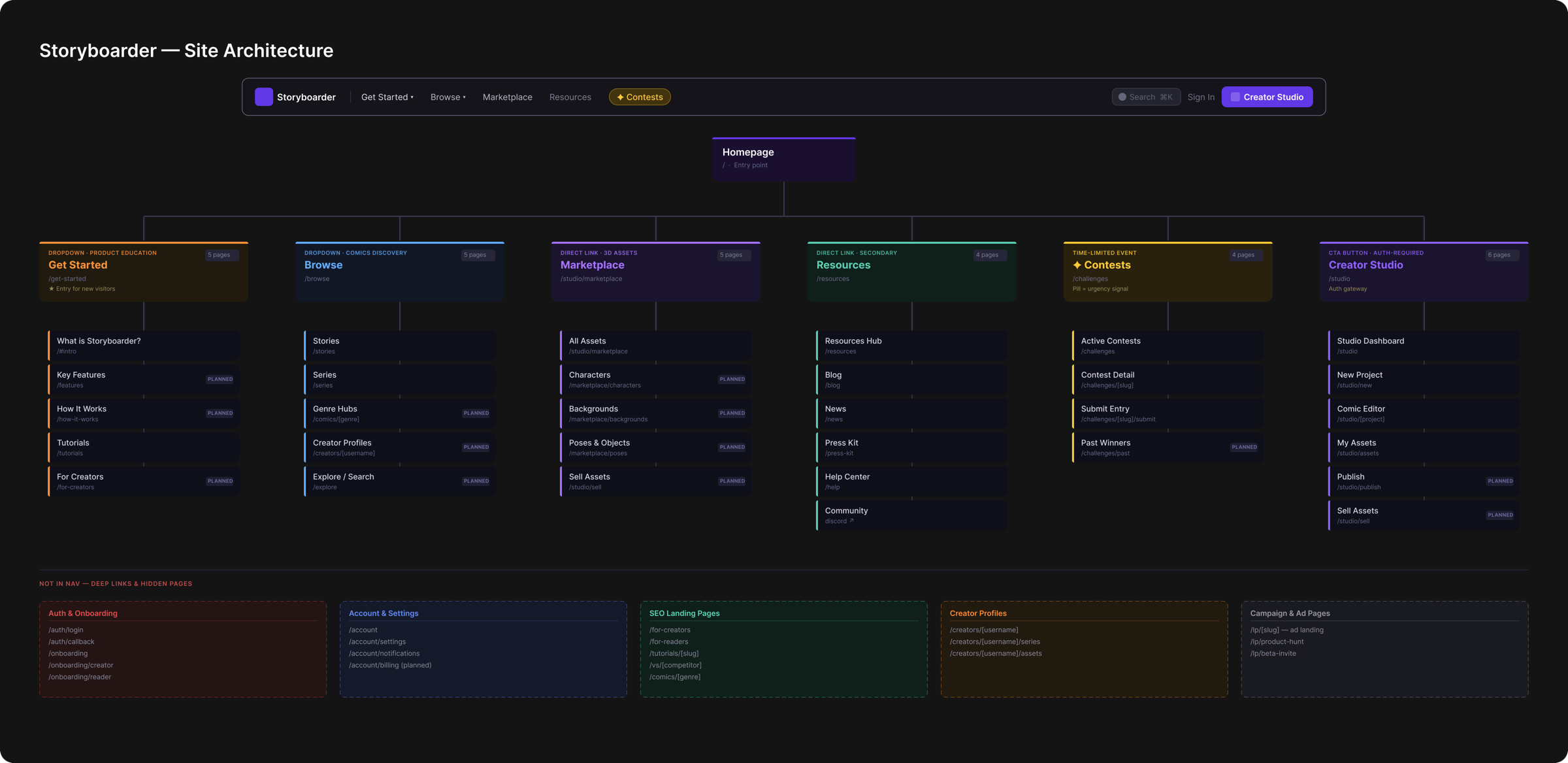
§ EInformation architecture

12 nav items collapsed to 3 verbs and 8 destinations. The IA reads left-to-right as a workflow: Make → See → Join.

01Make
  • Build (3D scenes)
  • Cast (characters · VRoid)
  • Frame (2D editor)
02See
  • Made With (community gallery)
  • Showcase reels
03Join
  • Pricing · Request access
  • Manifesto
  • Updates · changelog
Part 03

Identity.

Before

Storyboarder

After

sumugi
Kanji
Pronunciation/ˈsuː·muː·ɡi/

to weave · to spin a thread into cloth. Short, ownable, phonetically stable across English, Japanese, and European markets. A new-category product can't afford a name that locks it to a feature — "ComicMaker3D" would have dated it before it shipped. Sumugi implies craft and assembly without claiming territory it doesn't own yet. The weaving metaphor arrived pre-loaded: users already described their work as building a story panel by panel.

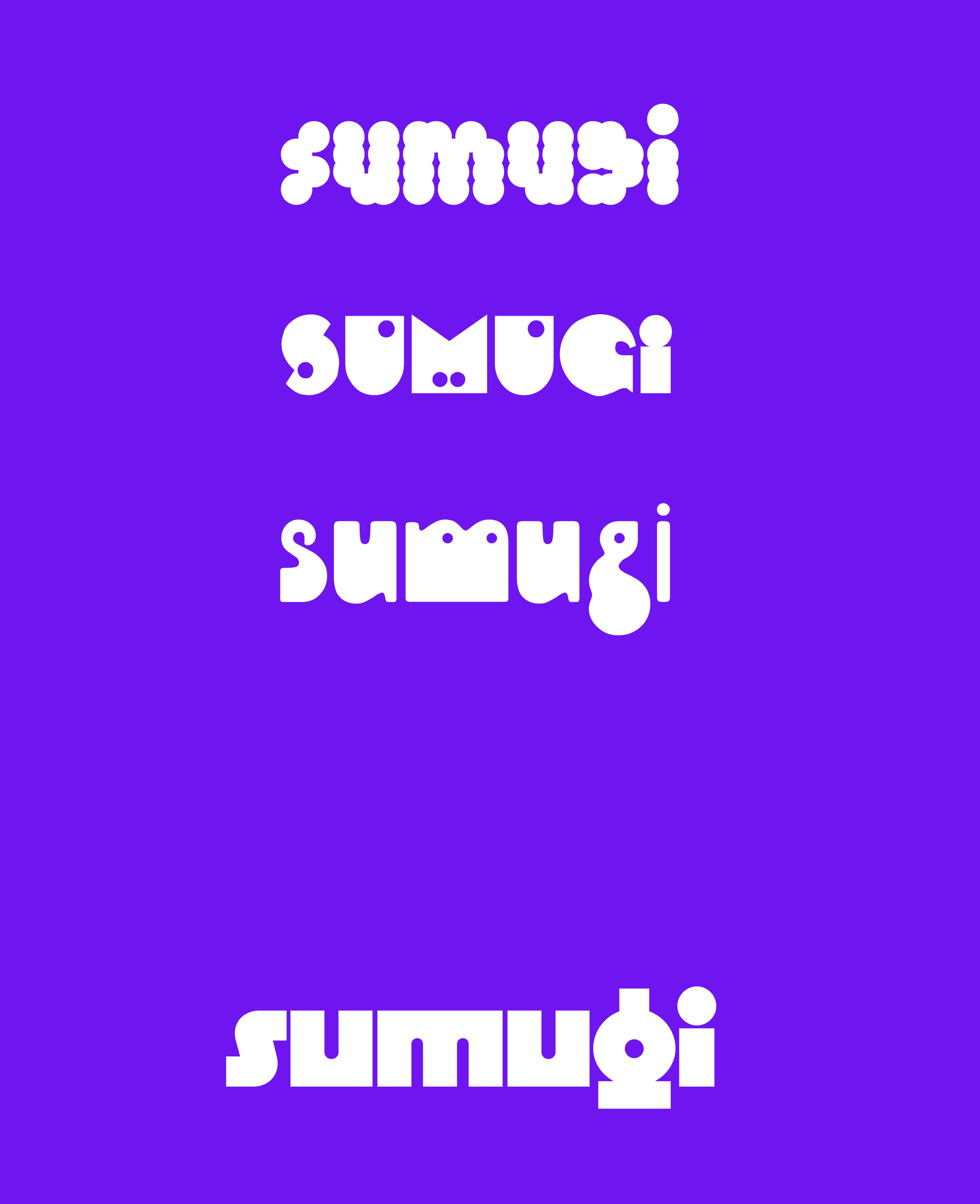
§ ALogo experiments
Sumugi logo explorations
Four explorations — weight, bubble tension, and descender treatment
sumugi

Final wordmark set in Megazoid. Lowercase only — a quiet brand that lets the comics do the shouting.

§ BColor system

#7E31F2

Electric violet

Primary brand · CTAs

#6F15F0

Deep violet

Hover · pressed states

#4F0CBB

Ink violet

Backgrounds · hero wash

#F231F2

Ultra magenta

Accent · mascot highlight

#F2E531

Signal yellow

Alerts · new-feature ribbon

§ CTypography

Display

Megazoid

Display + logomark. Bubbly, dimensional, comic-native — the shape of the product in a single typeface.

Body

Storyboarder Sans

UI + body. Custom variable sans by Charles Forman — neutral at 400, punchy at 800, stays out of Megazoid's way.

Part 04

Website.

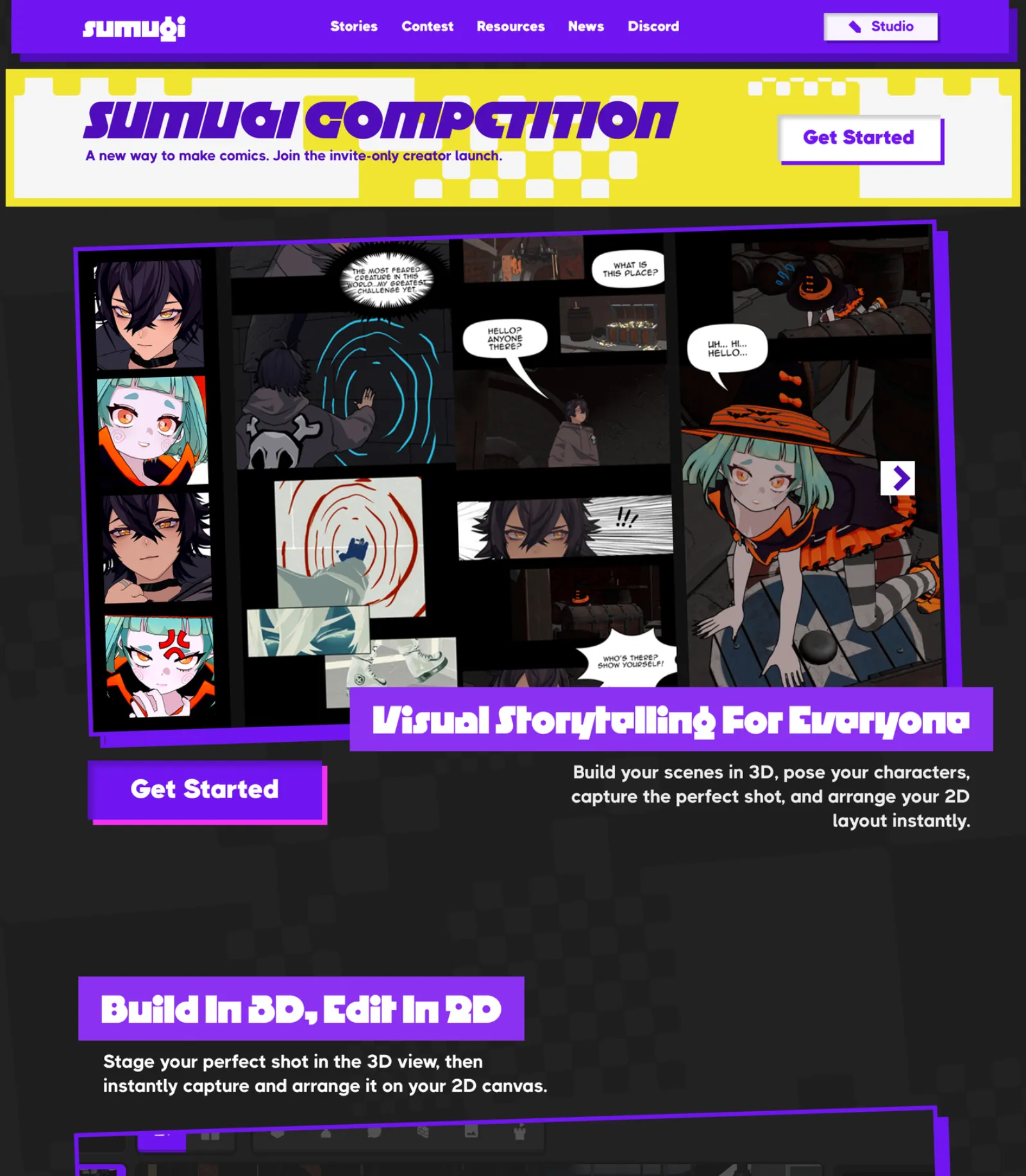
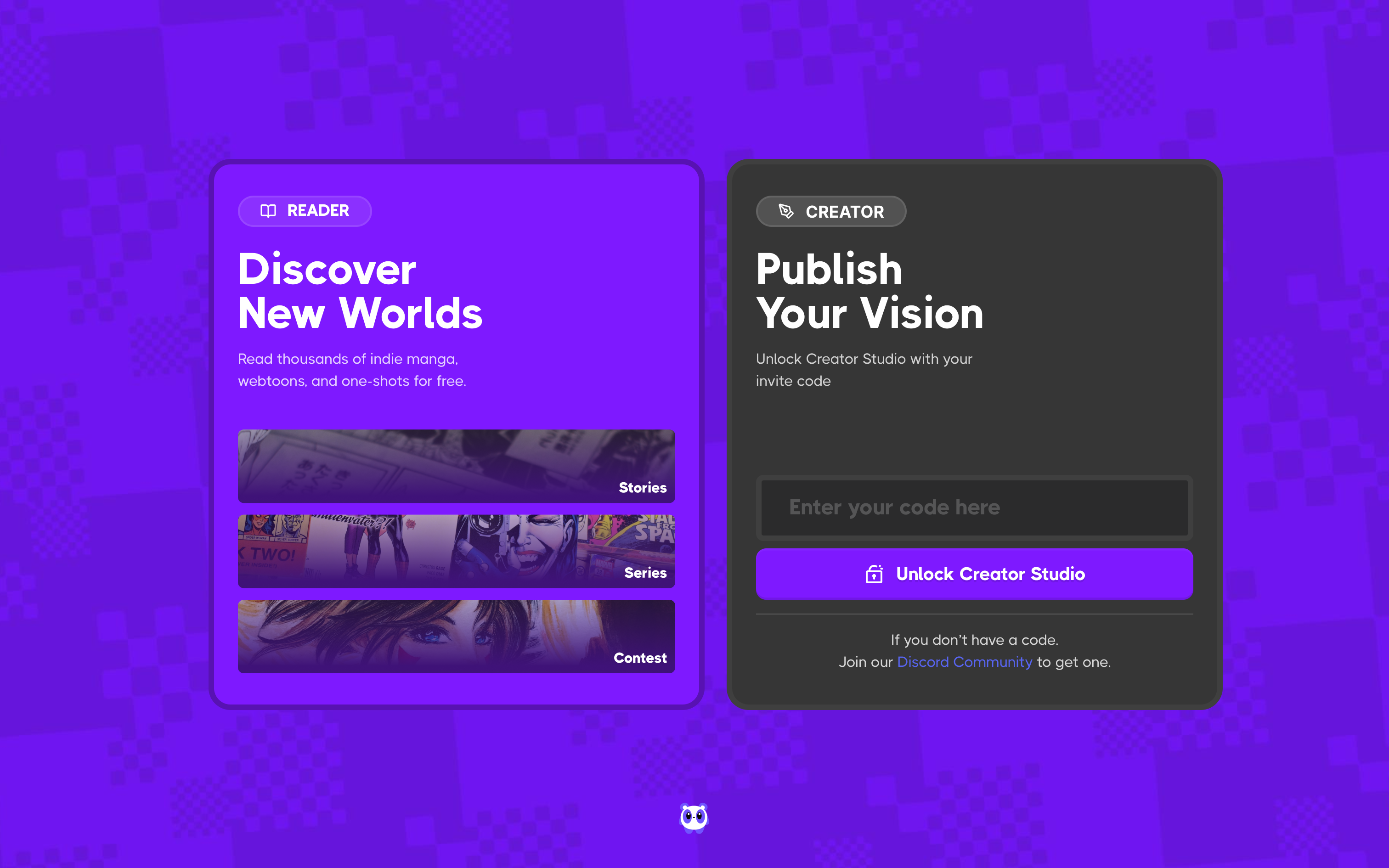
Sumugi homepage — final design
Homepage · sumugi.com
Sumugi campaign landing page
Campaign · #MadeWithSumugi launch
§ AWebsite redesign · before / after

01 · Hero

Before

Before — Hero

After

After — Hero

Replaced tool-feature headline ("Make Comics without drawing!") with creator-identity positioning ("Visual Storytelling for Everyone"). Added Megazoid wordmark, film-grain texture, and invite-only competition banner — signaling community exclusivity over feature demonstration. The old hero positioned the product; the new one recruits a specific identity.

02 · Feature Demo

Before

Before — Feature Demo

After

After — Feature Demo

Applied Megazoid to section headings and introduced hard drop-shadows with -1.85° rotation to the product screenshot. The original section was visually indistinguishable from any SaaS tool — vanilla typography, flat screenshot. The tilt and shadow system embeds the brand aesthetic directly into the feature demonstration.

03 · Audience

Before

Before — Audience

After

After — Audience

Collapsed four audience categories to three, reordered to surface Comic Creators first, and replaced flat grid cards with angled asymmetric layout. Removed the "versatile platform for every storyteller" framing — a hedge that diluted creator-first positioning. Fewer categories, cleaner hierarchy.

04 · Testimonials

Before

Before — Testimonials

After

After — Testimonials

Restructured social proof from a low-contrast dark utility section to white cards with hard 16px violet drop shadows. Creator names in hot pink (#F231F2) read as attribution rather than metadata. The original buried community proof in the same visual register as every other section — the new treatment makes it unmissable.

05 · Community CTA

Before

Before — Community CTA

After

After — Community CTA

Added the Sumugi chonk mascot as an emotional anchor above the headline. Placed Discord and Studio CTAs at equal visual weight — treating community entry as equivalent to product entry. The old version framed Discord as secondary; this one signals that the community is the front door.

06 · Made with Sumugi

Before

Before — Made with Sumugi

After

After — Made with Sumugi

Promoted community-created content from a plain card grid to a showcase with hot pink drop shadows and violet creator attribution. The original "Check out these cool stories" framing positioned the gallery as supplementary. The new layout treats creator output as the primary hero — consistent with the research finding that the gallery drove 2.6× higher return visits than feature-led layouts.

Part 05

Reflection.

§ BLessons learned
  1. 01Community is the product, not the feature.

    We led with the workspace because it's technically impressive. But people didn't come back for the renderer — they came back to see what others had made. Moving the gallery above the fold beat every feature-led layout by 2.6×.

  2. 02New categories need a demo, not a definition.

    9 of 12 people went blank when we said "3D workspace for 2D comics." A 6-second autoplay of a finished panel — no text — got 11 of 12 to describe it correctly.

  3. 03Flat design is a positioning statement.

    The old site was clean and completely forgettable. The Megazoid wordmark, electric violet, film-grain — all of it said "we care what things look like." Design without a point of view recruits no one in particular.

§ CShipped
  • Marketing site · 5 pages
  • Brand system · logo · color · type · voice
  • Launch campaign · #MadeWithSumugi
  • Design system · 14 components
  • Tokenized Tailwind theme
  • Email templates · welcome · invite · changelog
  • Motion principles · 6 loops
  • Founder handoff doc · 18 pages
Visit storyboarder.com

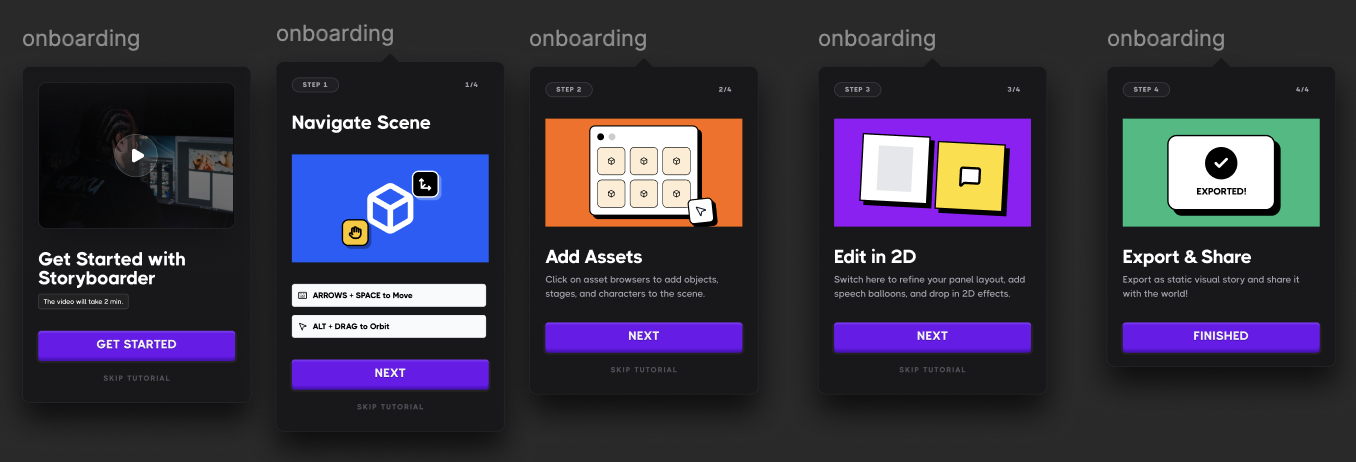
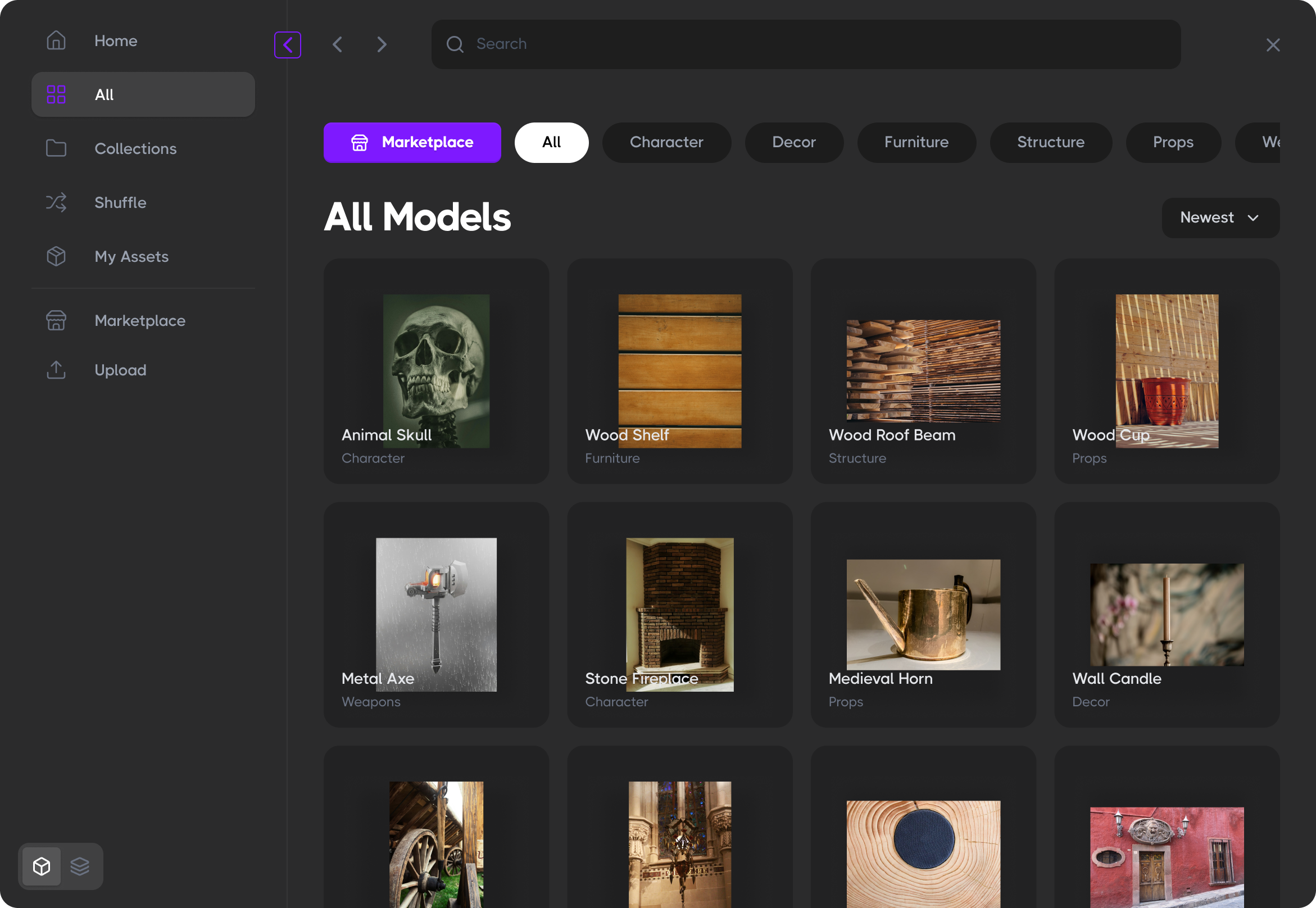
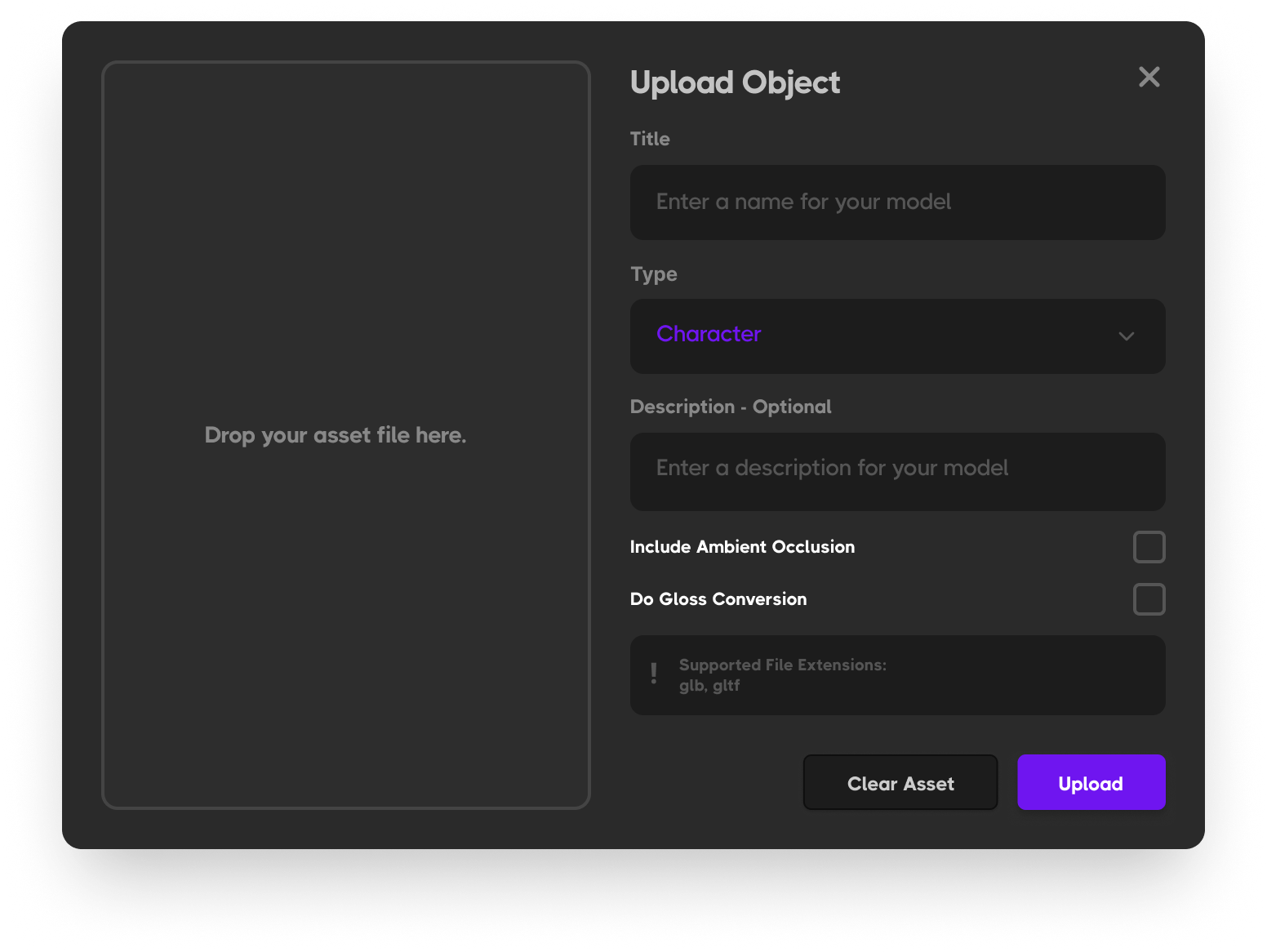
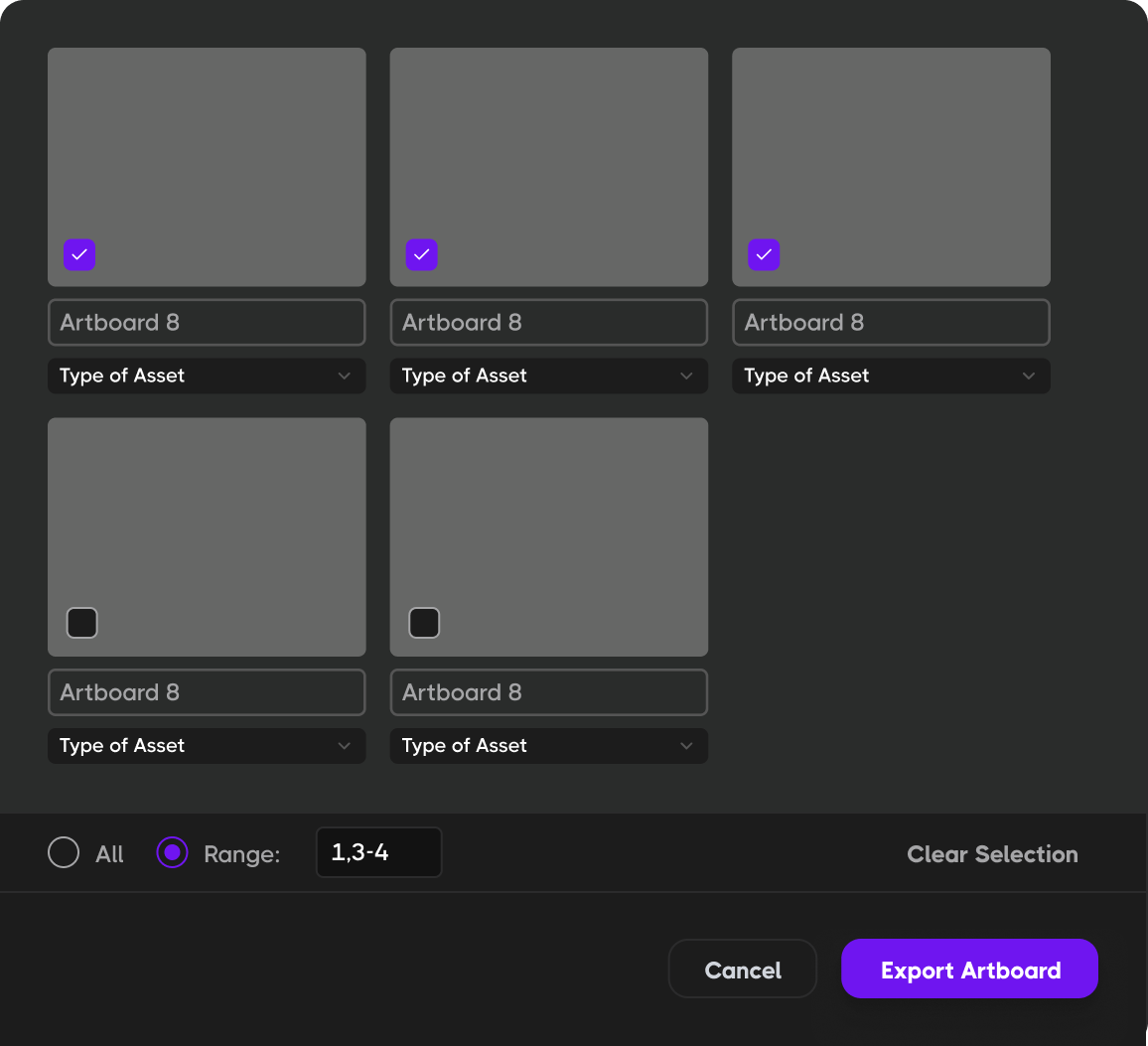
§ Product · the creation tool

01Build3D scene · camera
02CastCharacters · VRoid import
03Frame2D panel editor

Conceptual user flow · core task, not shipped screens